
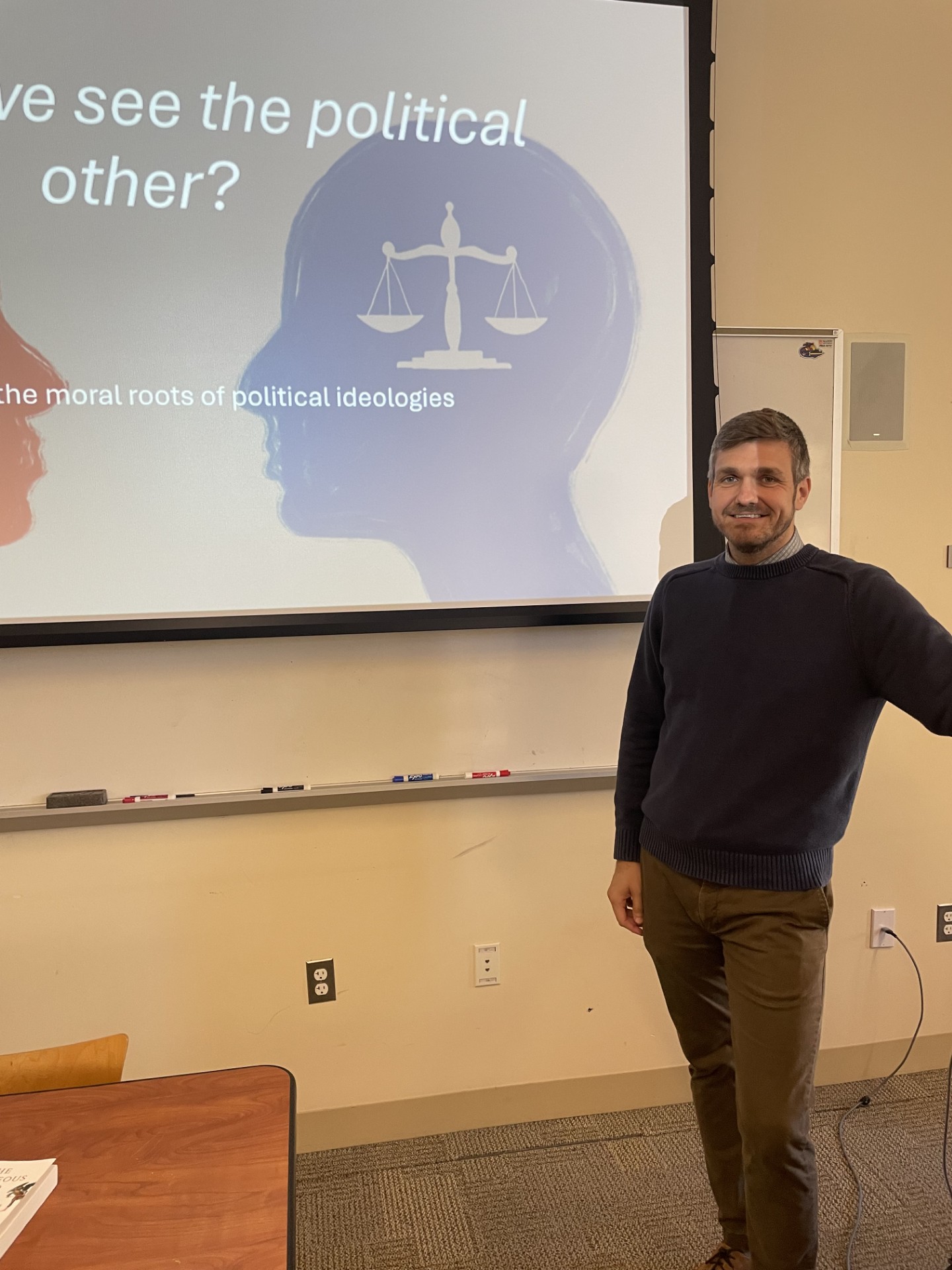
How Do We See the Other Side? with Mr. Lewis
In the latest installment of pre-election Lunch and Learn sessions on October 23, 2024, St. Paul’s Theory of Knowledge teacher, Mr. Lewis, opened with the question: “How do we see the other side?” His lecture drew on concepts presented by renowned social psychologist Jonathan Haidt in his 2013 book titled The Righteous Mind: Why Good People are Divided by Politics and Religion.
Haidt reviews the polarization afflicting today’s modern society, observing that humans become polarized when they believe their cause is more righteous than their opponents. In response to this great problem, Haidt asserts that empathy could act as an antidote. He proposes that if humanity could learn to acknowledge and contemplate the other side’s opinion, society would flourish as one united people. The current societal divide has impeded our ability to know someone whose views contrast with those of our own. Haidt points to the tensions that develop between friends due to varying points of view, inevitably making it difficult to sustain a relationship with someone with whom you disagree.
Mr. Lewis also highlighted Haidt’s discussion of the origins of our morals as a human race and in our communities. Two contrasting views explain when and how morals emerge: either we are born with them or develop them as we go through life. Within this context, Mr. Lewis introduced the three views on how decisions are made. First, Plato reckoned that in human morals, our skills of reasoning triumph over basic desires. Thus, the standards which society considers reasonable became the guiding principle of our morality. Alternatively, Founding Father Thomas Jefferson believed that both reasoning and sentiments are equal partners, and both contribute to our values. Finally, Scottish philosopher David Hume held that morals come from feelings, discerning that our passions guide our morality.
In his book, Jonathan Haidt uses a metaphor to create an image of the conscious mind versus the involuntary, subconscious mind. He presents the example of the elephant and the rider, questioning whether the elephant or its rider has control over their destination. The rider represents the conscious mind, with all its rational functions and voluntary power, while the elephant represents other factors in the human mind, from emotions to the subconscious. Haidt concludes from his analysis that humans are emotional actors who act on intuition, acting first and justifying their actions later.
Throughout time, ethicists have searched for a singular factor in determining ethical actions. Mr. Lewis pointed out that Haidt presents what he calls the “moral taste buds” of humanity. While some emphasize other elements, Haidt focuses on 6 foundational factors in the evolution of societal standards in humans: care, fairness, loyalty, authority, liberty, and sanctity. Nature built these factors into humanity, but prioritization can change as an individual journeys through life. In society, these are regarded with varying amounts of importance, depending on associations, life experiences, political views, and more. Mr. Lewis revealed that, in this framework, morals become “binding and blinding”, with humanity tending to live in their own moral world without paying heed to another outside of their personal bubble.
Haidt sought to answer the question: “Where do we go from here?” The diminishing of world partisanship and an increase in unity begins with every one of us. Mr. Lewis emphasized the need to reframe our societal goal and work to improve it. We need empathy to appreciate how others see political issues. Structural changes in election procedures, electoral district drawing, and campaign donation policies would also aid in decreasing tension and distrust. We must realize that the contrasting opinions of conservatives and liberals serve as a yin and yang of American society, acknowledge that both sides have valuable insights, and appreciate that we require both sides for national balance and unity.




Leave a Reply