
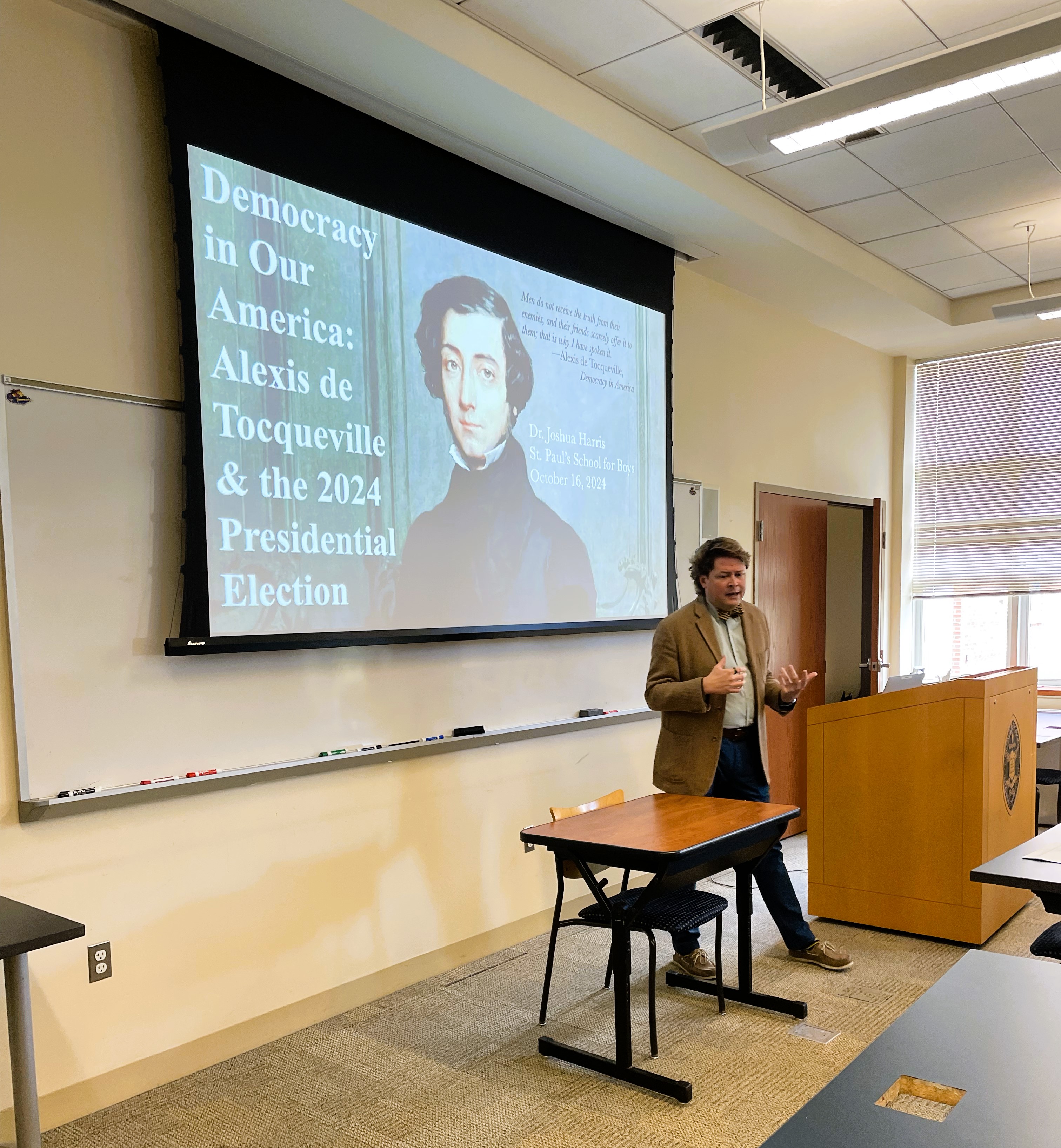
Democracy in America by Alexis de Tocqueville Featuring Dr. Harris
By Max Yurko
On Wednesday October 16, Upper School English teacher Dr. Harris treated the Lunch and Learn audience to a review and modern-day analysis of Democracy in America by Alexis de Tocqueville. This 18th century take on the political system in America gave amazing insight into today’s landscape. Introducing the Frenchman who toured America in 1831, Harris presented de Tocqueville’s political opinions and the influences on his viewpoints.
Alexis de Tocqueville grew up in the aftermath of the French Revolution and Napoleonic Wars, both of which had great impacts on his views on the tensions between aristocracy and democracy. Flustered with the French political system and desiring to study various forms of government, he sought opportunities abroad. His time in America observing the country’s unique style of government inspired his masterpiece: Democracy in America.
On analyzing the American democracy, de Tocqueville discovered strengths and weaknesses in the American political and electoral system. He presumed that democracy’s downfalls would pertain to racial inequality, miniscule executive powers, and the rise of consumerism, among other things. One of de Tocqueville’s most stringent warnings hinged on the danger of “tyranny of the majority.” Particular to democracy, the majority may dominate and oppress the minority, forcefully molding their culture, customs, and norms to fit the general scheme. Thus, the majority would exert its desires to the extent they suppress the natural liberties and freedoms of the minority.
De Tocqueville also referred to the “Crisis of the Election.” He revealed his fondness for the decreased power of the executive office as he believed that increased presidential authority would lead to greater problems in the country. Dr. Harris identified the title of “president” as an indicator of his limited powers. A president’s peers refer to him as “Mr. President,” a very humbling label, indicating the miniscule control which he has over the government and country. Yet, as American democracy continued, the office became an important symbol for the nation as the public “group[ed] themselves around” (de Tocqueville) and “personif[ied] their theories in him” (de Tocqueville). Through this symbol, the majority projected their views, sculpting his political stances. Today, candidates often utilize a past president as an icon in their campaigns to represent the values with which they desire to be identified.
In addition to describing the seat of the president, de Tocqueville also analyzed the electoral college. He appreciated the electoral college for its ability to prevent situations of “tyranny of the majority” by taking some authority out of the hands of the people. The electoral college barred large states from dominating the election, allowing smaller states to retain a voice in the election and checking the power of the majority. De Tocqueville argued for a balance between aristocratic and democratic institutions in order to maintain democratic values, while evading “mobocracy” or “tyranny of the majority.” Interestingly, some in today’s political landscape have proposed eliminating the electoral college.

To cap off his lecture, Dr. Harris revealed De Tocqueville’s views on the election season. De Tocqueville noticed that when we near the election, it “becomes the greatest and so to speak sole business preoccupying minds,” discovering the drastic impact which the election has on the American mind. This preoccupation of the mind seemed ironic, especially given that the president possesses few overarching powers. Nonetheless, election tension escalated to near civil war, with “agitation [becoming] more lively” (de Tocqueville). Dr. Harris noted that campaigners tend to disclose harmful information about their opponents late in the campaign so it will remain fresh in the minds of the American people. This has become known as the “October Surprise.” De Tocqueville observed that after an election, tensions dissipate, and life returns to as it was prior to the election.
Dr. Harris also shared various other thoughts by de Tocqueville concerning the election and democracy. De Tocqueville unveiled that the size of America aids in keeping violent cross-partisan collisions “less probable and less perilous.” Describing the “moment of the election” as a “period of national crisis,” de Tocqueville realized that tensions could not bubble over into actual confrontation if people who disagreed remained geographically separated. Of course, technology and transportation were quite different in his day.
Finally, he believed that “the choice of the president matters only moderately to each citizen, but it matters to all citizens.” While each individual may feel relatively small effects in their own life relative to the winner of the election, the choice of leader impacts all citizens through its effect on the success of the country.



Leave a Reply