
By Marta Karpovich ’25
Science is a series of observations that one must continuously reconcile with pre-existing knowledge. Amateur and hobbyist astronomers spend their lives chasing observations and sorting them into extensive lists. These albums of 400 or 500 observations of the natural world are used in competition with each other — whoever has seen the most things more accurately than anyone else wins.
One such observation is the solar eclipse, which happens once every 18 months or so, though not in the same place on earth. While an eclipse is witnessed in Africa, North Americans may not be able to experience this solar phenomenon for another 300 or 400 years. There are plenty of scientific explanations for this, the simplest being that the alignment of the sun, the moon and the earth is just right in different locations around the globe every year and a half, causing the moon to completely block the sun from the earth’s view. However, the eclipse still takes everything we know about the universe and flips it on its head for four or five minutes while the light in our little corner of the earth disappears. The sun is 865,000 miles in diameter, while the moon’s diameter measures 2,160 miles. The earth is somewhere in between, with a diameter of about 7,918 miles. While a multitude of theorems and calculations account for such a strange phenomenon, it ultimately tells a story of the underdog eclipsing the big guy for just a few moments, questioning the basic reality we had previously accepted.
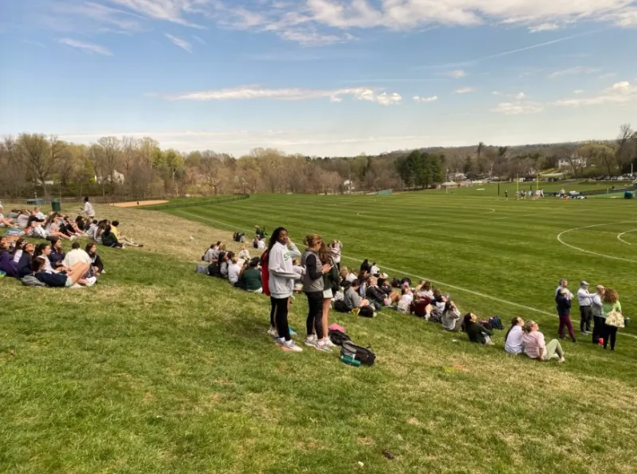
The eclipse, however, is about much more than science. The SPS community gathered on campus on Monday, April 8 with solar-approved glasses to witness the eclipse in groups of teachers and classmates alike. From the youngest lower schoolers to the very oldest seniors to a wide range of faculty, community members spilled out of buildings in troves and camped out on the grass for a few hours to watch the sky together. While some broke their phones trying to take pictures of the sun and others had to grab a few extra pairs of approved glasses from faculty, everyone was perfectly content to look upward with the rest of the St. Paul’s community.
The students on those fields were not particularly interested in grabbing a telescope and calculating the distance between the outermost rim of the sun and moon. Many had no penchant for science and its prospective theories at all. They just wanted to look. Like true scientists, the objective was to observe but unlike some astronomers, they wanted to share this observation with others. There was no competition over who was seeing it more clearly than anyone else, nor if anyone had a better idea of what was going on than their classmates. Rather, the moment was one of communal recognition in a shared experience, one that everyone was more than willing to acknowledge as belonging just as much to another as to themselves.
In a way, this was an act of surrender. Society at large, especially right now, is reaped in confrontation, disagreement, and debate. We live in a constant state of competition with each other, comparing observations and conflicting over whose reconciliation of this observation with a pre-existing set of facts is more accurate. From 2:00 pm to around 4:30 pm, however, all of this was set aside. The northeast sector of the United States surrendered to the power of observation without acting on the underlaying desire to explain it.
For a moment, we were all willing to acknowledge that what we saw was just the same as what everyone else was seeing, marking the presence of a communal observation that was indisputable before our eyes. The moon was in fact eclipsing the sun and it was beautiful. There didn’t have to be anything more to it. Political opinions were irrelevant. Religious beliefs were irrelevant. Individual stances on foreign policy were irrelevant. The community shared the beauty of the moment at face value, accepting that it was important to everyone on campus all at once.
There is a lot we can learn from science beyond what is found in the textbooks stacked in every science classroom on campus. Ancient peoples learned much of what they knew about the moon and the sun from eclipses. In the early 20th century, experimenters used eclipses to verify Einstein’s theory of general relativity. No one at St. Paul’s was aiming for such lofty goals as verifying the newest scientific discovery. But the eclipse did teach us something about the universe that we may not have thought about before.
Dr. Jerome Bruner, a deceased Harvard psychologist, argued that one should be able to teach absolutely anything to absolutely anyone about the universe at an intellectually appropriate level. Maybe we don’t know the exact distance between the sun and the moon or the calculations that make them align in such a way. Maybe our intellectually appropriate lesson is that the universe is bigger and more expansive than we could ever imagine. Maybe it is that there are so many inexplicable phenomena in the universe that we can give up trying to explain them. Maybe our lesson here is that it is enough to just keep on looking.
Or perhaps the bigger lesson is one on perspective: the eclipse teaches us that while we in Maryland are watching the world grow darker, absolutely nothing is happening to the sky in Ireland. And that is okay. It doesn’t make the reality of us and the Irish any less reconcilable or real. They are merely different experiences on the very same earth, caused by a difference in perspective. Maybe we can learn to look at the world together, recognizing that what we observe is a product of our perception just as much as it is anyone else’s. Maybe we can learn to be silent, observing the universe without trying to reconcile it with everything else we already know.


Leave a Reply