
By Grace Yurko ’25
Each morning cars stream through the gates and past the signs that bear our school’s name: The St. Paul’s Schools. We wear it on our sweatshirts, display it on car windows, and send emails with it in our address. But do we ever stop to consider what this name signifies? Who was St. Paul? What are we telling the world about who we are? When we claim our affiliation with St. Paul’s, we are signaling a part of our identity. Clearly, an institution and its members should realize the origin and character of its namesake, and perhaps consider whether our lives embody its principles.
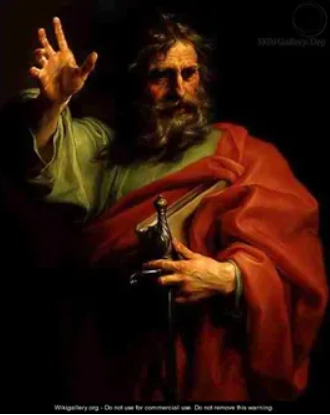
The man we know as St. Paul was also called Saul of Tarsus, which was his birthplace in modern day Turkey. He lived from approximately 4 BCE through 64 CE, so he is thought to have been born five to ten years after the historical figure documented as Jesus. Paul was a member of the ancient Jewish sect, the Pharisees, who were highly educated and strictly observant of tradition and law. Prior to his conversion experience, Saul actively persecuted Christians and sought to eliminate Christianity from the earth. The irony of this aspect of his youth strengthens the message he became known for. According to Luke’s accounts in Acts and Paul’s own affirmations in Galatians, he was on his way to Damascus when a vision changed his life. The vision revealed to Paul that God had chosen Jesus to be the promised Messiah. Three years later, he went to Jerusalem to meet with some of Jesus’ remaining followers and afterward launched a twenty-year mission to spread the messages of Christianity.
Whatever one believes about what exactly happened to Paul that caused this change of mindset, Paul’s life as an apostle and missionary took him from persecutor to persecuted. The unpopularity of the growing Christian movement with the Roman authorities made Paul’s mission a perilous one, yet he worked tirelessly to spread the messages of Christianity. One of his main tools for accomplishing his mission came in the form of letters. These thirteen groups of letters became known as epistles, linking them to the name of The St. Paul’s Schools newspaper The Page & The Epistle. Published as books of the New Testament, nine of the epistles were to churches and four to individuals, and they encouraged the founding beliefs and principles of Christianity. For his trouble, Paul was flogged, imprisoned in Rome, and eventually beheaded under Roman emperor Nero. St. Paul may have been the most influential person in the growth of Christian theology, spreading the message through his voluminous writings.
So, what exactly were his messages? First and foremost, St. Paul sought to strengthen devotion to Christianity, increase knowledge of the sacrifice Jesus made for humanity, for our relationship with God, and to encourage the Church. But his messages also offer guidance on living with hope for a greater world. With a diverse community at St. Paul’s reflecting varying backgrounds and traditions, these guiding principles should be how we represent ourselves to the world. Paul’s letters begin chronologically with Thessalonians, although these letters appear after seven other books by Paul in the New Testament. Throughout this letter, and all his subsequent writings, Paul includes the common thread of gratitude. He opens with thanksgiving, reviews the struggles his readers may be enduring, encourages them to be thankful, and reminds them to live with hope and joy.
Paul follows Thessalonians with one of his most well-known and instructive verses found in his letter to the Corinthians in which he emphasizes that followers should exhibit love as the foremost virtue in all they do. He writes, “If I speak in the tongues of men or angels, but have not love, I am a resounding gong or a clanging cymbal” (NIV, 1 Corinthians 13:1). No matter how eloquent and self-assured our speech is, if we do not start from a place of compassion, we only add meaningless noise to an already noisy world. Do we grab the microphone and announce our presence, or do we listen and find a way to express love for our community? He follows this declaration with guidance on the character of love: “Love is patient, love is kind. It does not envy, it does not boast, it is not proud. It does not dishonor others, it is not self-seeking, it is not easily angered, it keeps no record of wrongs. Love does not delight in evil but rejoices with the truth. It always protects, always trusts, always hopes, always perseveres” (NIV, 1 Corinthians 13:4-7). In this passage, Paul specifically instructs us toward patience and kindness. As members of the St. Paul’s community, we are to avoid envy and pride, honor others, and seek truth. Additionally, we are not to catalog our grievances against each other or the world but instead make our lives examples of love, hope, and perseverance.
Paul also gives us advice on where to find the strength to be examples of love, faith, and hope. He tells us, “Whatever is true, whatever is noble, whatever is right, whatever is pure, whatever is lovely, whatever is admirable—if anything is excellent or praiseworthy—think about such things” (NIV, Philippians 4:8). In other words, turn our attention toward the positive, toward the uplifting and inspirational. Avoid dwelling on the negative, do not fill our minds with angry thoughts and images, and resist the urge to focus on outrage and dissatisfaction. We become what we visualize. By making a conscious decision to fill ourselves with images of which we aspire, we become better, happier, and more beneficial to the world we seek to influence. None of us are perfect examples. As Paul says, “all have sinned and fall short of the glory of God” (NIV, Romans 3:23). But if we claim to be members of this community called “St. Paul’s”, and we make the choice to tell this to the world, then we should at least attempt to lead with uncomplaining gratitude, love, and reverence for something bigger than ourselves. We are to give hope to the world. We are not to magnify its sorrows but to show that we can each make a difference in one life, or one thousand. We are – St. Paul’s!




Leave a Reply