
By Torben Heinbockel ’26
Motor vehicle accidents are the leading cause of death for teens 15-18 years old in the United States. After several tragic crashes involving high school students in Pennsylvania, two Pennsylvania Congressmen, Representative Charlie Dent, and Senator Bob Casey, introduced a resolution, on September 6, 2007, establishing National Teen Driver Safety Week (NTDSW). NTDSW is held annually on the third week of October. The goal of NTDSW is to keep teen drivers safe and support the mission of the National Organization for Youth Safety (NOYS), which began in 1994. The NOYS is a 60-member national organization that reaches 80 million youth and adults, and its mission is to promote health and safety in youth driving.
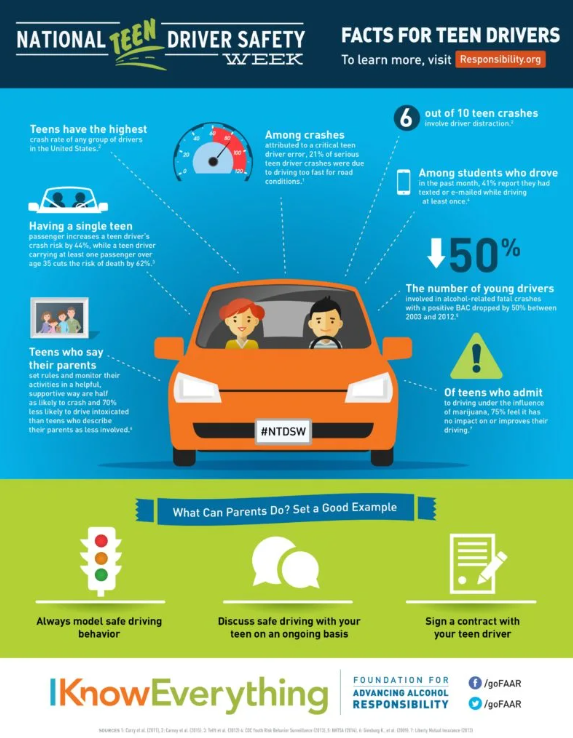
The primary causes of car accidents in teens can be attributed to inexperience, distractions, and high speed. The “I Know Everything” (IKE) program has created a short and helpful video refresher that covers the rules of the road, as well as the infographic pictured below that summarizes common driving risks. Even though teen drivers may think they are knowledgeable in how to drive safely, less than half of the high school students who participated in a survey run by the IKE organization, earned a grade of “C” or better. It is important to realize that teens should practice driving not only when the weather is favorable, but also at different times of the day (e.g., morning, dusk, nighttime) and in varied weather conditions (e.g., snow, rain) with a licensed driver.

A three-tier graduated driver licensing system (GDL) system (i.e., learner permit, intermediate or provisional license, and full or unrestricted license) is in place in all 50 states and in the District of Columbia. Specific components, however, vary by state, such as the age at which teens can obtain their learner’s permit. For example, Maryland teens may obtain a permit at 15 years and 9 months; however, in Kansas and Iowa, the minimum age is only 14 and 9 months. In Maryland, applicants must be 18 years old to obtain a full license, whereas in Kansas and Iowa, the requirements are only 16 years 6 months, or 17 years old, respectively. The latter two states have the youngest minimum requirements for all tiers of the licensing process among all 50 states and the District of Columbia.
Even when teens have received their learners’ permits, and required lessons, parents are encouraged to serve as active teachers and good role models when teaching and reinforcing driving skills and safety precautions. Parents should not depend on driver’s education programs to cover all the major procedures and safety protocols. Teen drivers are required to take a driver’s education course before obtaining a learner’s permit in high school, online, or through a private program before obtaining a full license. Courses cover all the essential knowledge: road signs and signals, changing lanes, basic vehicle maintenance, emergency situations, alcohol safety, drug awareness, distracted driving, bicycle and motorcycle awareness and safety, organ donation, handicapped parking, and more. The Department of Transportation offers quizzes that incorporate logic, explanation, and reasoning to prepare you for the questions on the test.
Common factors that impair teen driving performance include sleep deprivation, nighttime driving between 9 p.m. and 6 a.m., the number of potentially distracting passengers accompanying the driver in the car, and cellphone use when driving. Teens should keep in mind that there is a zero-tolerance law for anyone caught drinking and driving. While it is illegal to drink under the age of 21, it is also illegal and deadly to drink and drive. The blood alcohol concentration in a person under 21 should always be 0.00 and not just under 0.08, which is the legal limit for drivers over the age of 21. Therefore, it is illegal for teens to drive with any measurable amount of alcohol in their system. Failure to abide can result in long-term license suspension or revocation and fines.
Once teenagers are successful in obtaining a learner’s permit, it is up to their parents and/or older siblings and/or friends 21 years or older to hold a license or a minimum of three years, be seated next to the driver, and to encourage safe driving practices. Continuing to educate teenagers to practice safe driving skills is key to saving lives and preventing deleterious consequences with the law. Teens should be reminded of the enormous responsibility that comes with the privilege of driving. Inexperience, such as failing to wear a seatbelt, and reckless and impaired driving, can lead to fatal crashes for the driver and passengers. It goes without saying that drivers must also take into consideration the lives of other drivers and passengers, as well. Hopefully, a multi-faceted safe driving approach will improve the odds of survival for teens and for those on the roads with them.




Leave a Reply