
By Marta Karpovich ’25

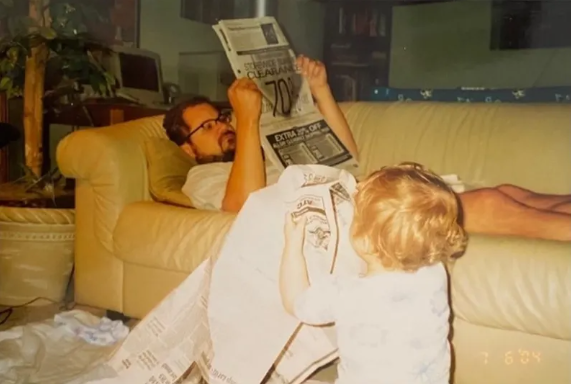
Source: Jill Karpovich
I will never read “Sophie’s Choice” again.
By the time I was 11 years old, I was a voracious reader. My days were spent lost in the worlds of Clarissa Dalloway, Mr. Darcy and Holden Caulfield, while I spent my nights cataloging every word the English language had to offer. I could talk about Sylvia Plath’s horrific demise at length, but I could not talk to you about the highs and lows of my day. English was the only language I knew, but literature was the only language I could speak.
All my life, my friends and family incessantly knocked at my emotional doors, only to be met with an automated recording of ferocious guard dogs and turned-out lights. My instinctual response to the sound of a doorbell was to drop flat onto the floor and army crawl to the nearest corner, hiding from the windows of my vulnerability. I was incapable of connecting on emotional levels any deeper than that of a relationship between strangers seated next to each other on an airplane. The mystery of my inner being would have made a riveting Sherlock Holmes novel, and everyone wanted to read it.
I hid myself in fictional worlds to escape a reality that felt much less real. Although I understood little about the world and declared incompetency in existence, I knew I could rely on my ability to spot a good metaphor and predict happy endings. I fell in love with protagonists and villains because I could not (would not) allow the curtain of my stoic indifference to lift, fearing exposure as a human susceptible to affection. Everyone was kept on a different page, separated by bookmarks. No one could get through to me.
Until one night, I turned on my bedroom light and found a thick, worn-down copy of Bill Styron’s masterpiece lying flat on my bed. I opened the front cover and haphazardly flipped through the frayed pages, eventually tossing the novel aside. It lied open on my bed, the dedication carelessly exposed:
“To the Memory of My Father”
(1889 – 1978)
The next day, I asked the only beneficiary I could think of about this mysterious gift. My father told me that he thought I would like the book and ought to give it a chance. However, fearing retribution for giving a horrifically dark banned book to his 11-year-old daughter, my dad warned that my reading should be kept a secret. We could discuss its contents out of maternal earshot.
These discussions very quickly built upon each other, creating a bridge between my father and me. We had found a means of connection, held together by our mutual passion for literature and bolstered by the strength of prose. For years, we had been staring at each other from opposite sides of a river of emotional depth. We had consistently failed to meet in the middle, our lack of fluency in the language of vulnerability the culprit of our perpetual misunderstanding. It was only when we realized we were both fluent in the language of prose that we could learn to understand each other.
My father and I are eerily similar. I inherited his Fred Flintstone feet, his paddle thumbs and, one could argue, his smile. However, it is on a deeply psychological level that our very souls seem to reflect each other. I never understood his short temper or his need to live according to a strict schedule. I thought I would never understand his means of coping with life, and even resented him for it. Yet, I soon realized that I am just the same. I have the same grievances, hatred for people, quick temper, hurried existence, and tendency to audibly talk to myself no matter who is around. We have the same tics and bad habits, as well as the same strengths of character.
Our true connection began, however, when we realized that our view of the world and approach to living in it is processed through the same eyes and the same heart. My father and I share a hatred for the world and the ills of society. Yet, our antipathy is only surface level, as we also share the same spiritual connection to the vitality of the earth, humanity and ourselves. We have the same itch of ambition that drives us through our days and keeps us afloat. Exchanging words revealed that what I could not understand about him is just the same as what he could not understand about me. I now have the privilege of this understanding, and I can no longer call myself a victim of miscomprehension. It has brought about a much deeper sense of empathy and affection between us.
This newfound means of connection has remained a constant source of stability and strength throughout life’s many vicissitudes. A book left on my nightstand or frayed novel I throw at him in the living room is not merely a mutual appreciation for art. It is our way of lamenting about our shared emotional burdens that have weighed us down our entire lives. It is our way of reminding each other that someone sees, understands, and knows who we are. It is our way of sharing, and it is our means of comfort.
By exchanging words, my father and I can keep our vulnerability hidden from everyone else. No one else is a part of the conversation; they simply do not understand our approach to life. By acknowledging our sameness and love, my father and I have become each other’s biggest proponents and are the first to defend each other in familial battles. We stick up for each other first and foremost, with the understanding that sometimes we have to serve as the other’s voice.
The irony is not lost on me that “Sophie’s Choice” served as exigence for the stability of my relationship with my father. Bill Styron is not remembered as history’s best literary dad. He has been deemed quite the opposite, in fact. Yet, we do not read Styron to dissect his fatherhood. We read Styron to dissect his humanhood. Separating these two roles is the only way to understand why they appear as they do together. Fathers are only human. Paternity does not mean perfection and it certainly does not intrinsically require our acceptance. Humanity, however, is about understanding and working with what you are given.
I will never read “Sophie’s Choice” again because it is my favorite book. I have no desire to revisit Styron’s prose because his eloquence is not what brings meaning to this masterpiece. “Sophie’s Choice” means understanding. It means love. It means sharing. To reread the novel would be to tarnish the value of these gifts. Forever, “Sophie’s Choice” will simply be:
To the Memory of My Father.




Leave a Reply