
By Torben Heinbockel ’26
Halloween is just around the corner, and believe it or not, vampire-like sucking monsters are lurking everywhere. They hang out on trees, climb up the side of buildings, crawl around on the ground, and hide in crevices just waiting for the right time to pierce their victims and drink their sap!
This creepy crawly insect, the lanternfly, also known by its scientific name, Lycorma delicatula, is a native bug belonging to the order Hemiptera to parts of China and Vietnam. In 2014, this insect was first detected in Pennsylvania. It has now spread to over 14 US states in the East Coast and Midwest, and over ten other countries.
Researchers at Pennsylvania State University estimated that the statewide damage costs attributed to the spotted lanternfly amount to 99.1 million dollars in agricultural losses and 236.3 million dollars in forestry losses in the past year. It is thought to have arrived by “hitchhiking” on a shipment of stones from China in 2012.
This invasive insect likes to travel from plant to plant and often does so in large groups. Lanternfly adults typically mate in late August and the females begin laying egg masses on tree trunks, stones, and other sheltered surfaces in late autumn. Females lay their egg masses on objects, such as car interiors or their undersides, wheel wells, and truck beds. So, it is of paramount importance that people inspect their vehicles before driving. If they spot any egg masses, they should use water or bug remover to rinse them off or use a scraper to remove them. Each egg mass is about one inch in size, white in color, and usually covered with a white waxy substance secreted by the female to protect the eggs. Egg masses contain typically 30-50 eggs, and a female can lay an average of up to two egg masses before she dies. The eggs can survive the winter.
Lanternflies are univoltine, meaning that one generation lasts for an entire year. During this time, this bug can pack a powerful punch! Adults feed on the plant sap from approximately 70 different plant species by quietly walking or flying through the air like ghosts. Each adult comes up behind its victim and stabs it with its proboscis, which resembles a straw. By doing so, these pests can hurt and weaken plants, photosynthetically speaking, which can eventually lead to their deaths as the plant sap helps them to generate new leaves and fruit. Lanternflies favor hardwoods, like oaks and black walnut, and some of their favorite tree species are the heaven-of-heaven (Ailanthus altissima) and fruit trees, such as grapes and apples. Grape growers have reported severe damage to their vineyards with the infestation of the lanternflies, and this may cause devastating effects to their businesses. This same devastation may occur to tree-logging companies. As the lanternflies feed on the sap, they release a sugary-rich fluid called honeydew that acts as an attractant for wasps and ants and favors the growth of mold.
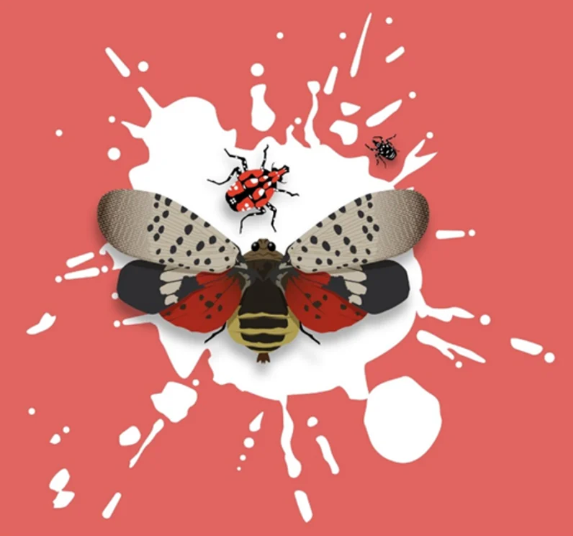
The lanternfly has four nymphal stages. The first stage emerges from an egg. During the first three nymphal immature stages, the insect appears black with white spots, and can be found from April to June. During the fourth and final nymphal stage (July-September), the insect transitions to a vivid red color, with white spots and black stripes. With each nymphal stage, the insect grows larger. Each bug has two pairs of wings; the front pair is gray with black spots, and the wing tips have speckled black bands. The back pair of wings are bright red with black spots, and the tips are black with white bands. The head and legs are black, and the abdomen is yellow with black bands. With its wings spread out, it can be mistaken for a beautiful butterfly, but don’t be fooled! It is nothing more than a planthopper in disguise, belonging to the same order of insects as cicadas and aphids. Planthoppers can transmit viruses or pathogens from one plant to another and are considered pests of crops.
You may ask, “Do I really need to kill them?” Well, the United States Department of Agriculture currently has a warrant out to arrest this invasive species and recommends that you kill it and report its location to local lanternfly hotlines. People have resorted to using shop vacs, rather than hiring a “ghostbuster,” as they are most effective in trapping them. To ensure that they die, dish soap can be added to water in the vacuum tank. Insecticidal sprays and soaps work well too. You can even wrap the trunk of your tree with sticky tape if you want to use a hands-off approach to dealing with them. Household vinegar works well, but direct contact must be made with the bug. Recently, milkweed plants have been found to kill them due to the poison present in their sap. Of course, you can outright remove any infested tree to prevent bug proliferation, but this may be an extreme measure and should be practiced as a last resort. So, the next time you see one of these bugs on St. Paul’s campus, you don’t need to ask, “Should I stomp or not stomp? Just do it! Regard this insect as a pest and follow what the Pennsylvanians do: “Kill it! Squash it, mash it, just get rid of it!” You will be helping the environment if you do!




Leave a Reply