
By Grace Yurko ’25

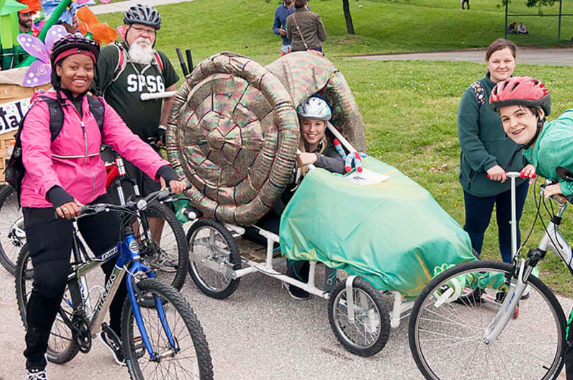
Photo of the Kinetic Sculpture Race by Dr. Hulbert
For some, the journey toward physical fitness can seem more difficult than defying the laws of science. For St. Paul’s physics instructor Dr. Stephen Hulbert, necessity and extrinsic reward were enough to propel him toward his own fitness journey. In August of 2022, the garage in the basement of the Kinsolving Gym became available. One of Dr. Hulbert’s educational passions is working with a group of students to build and submit a school entry for the Kinetic Sculpture Race, and the gym basement seemed perfect for the task. Dr. Hulbert, who spends most of his day down the hill at SPSG, had met his challenge. “This [space] was an amazing thing to secure for the KSR class. But, at the time, I found it physically challenging to walk up the hill from SPSG,” he remembers. This realization guided Dr. Hulbert to revisit his days of physical training.
St. Paul’s cross-country course, which winds through campus and over several hills, served as the perfect training ground. Since the school day starts early, the ideal time for training would be in the afternoon. Dr. Hulbert had previously helped coach outdoor track, which held practices after school, and integrated workouts into his personal schedule. “So, at 3:05, I quickly change into my workout clothes and walk down to the start of the course: but instead of coaching, I go for a run/walk,” he says. He adopted an interval training routine based on a method developed by running expert Jeff Galloway, a technique he had used years ago. The routine involves intervals of running for one and a half minutes and then walking for a half minute for recovery. “I don’t run fast. It usually takes me 50-60 minutes to run the three-mile course. But I get out in the fresh air and get the cardio benefits of keeping my heart rate up for that time,” he reflects.
The rewards of beginning any exercise program often come slowly. Obstacles such as muscle aches, fatigue, and slow results lead even motivated participants to abandon their goals. As Dr. Hulbert reveals, “It was exciting but exhausting. I still sleep pretty well the night after a run.” Facing the difficulties of attaining their fitness goals, most individuals need some external factors to stay motivated. Focusing on other related rewards often helps foster the will to continue exercising. For Dr. Hulbert, his passion for the Kinetic Sculpture Race also helps keep him going. For those who have never experienced it, the Kinetic Sculpture Race takes place in Baltimore’s Inner Harbor area each Spring. Contestants create human-powered all-terrain kinetic sculptures to race over land, water, mud, and sand. Successful entries combine creativity and craftsmanship with principles of physics and engineering.
His eyes light up as he recalls, “The KSR class is one of the most amazing experiences I’ve had in my six and a half years at SPSG. Getting to build something every day is a kick.” Students in the KSR class use what they know about the science of motion and learn how to use various tools and materials, culminating in a finished product to enter in the race. “So, my motivation was to do what I needed to do to be able to build. Plus, the actual race is 15 miles long and that can be exhausting, so I thought [that] I can’t do enough to prepare for [the race date of] May 6th.”
Beyond preparing for the race, Dr. Hulbert has set a personal, long-term fitness goal of completing the cross-country course one hundred times by August 2023: roughly twice a week. He’s seeing improvement in his energy along the way and has kept going even through chilly winter weather. Some weeks that meant only getting out there once, while other weeks he might be on the course four times. Dr. Hulbert credits necessity as the driving force, since he was “between a rock and a hard place” and just needed to get up that hill.
Most often, teachers stand in front of a room full of students and lead some type of lesson – a lecture, a class discussion, or a classroom activity – designed to impart information and help students learn. They might spend extra time reviewing concepts with individual students or posting additional material to guide understanding. Dr. Hulbert regularly employs these methods in the classroom, but his commitment to personal fitness is one that few teachers have. Sometimes, without even trying, modeling successful, healthy behavior serves as the best lesson of all.


Leave a Reply