
By Davis Boyce ’25
When I started this article, I was unsure how to address the daunting task of investigating the history of The Page, the St. Paul’s beloved School newspaper, the Page, and the St. Paul’s School for Girl’s school counterpart, The Epistle (which, which are now merged as a single body. When I learned of The Page’s ancestry, which dates to its founding in the 1930s, I was immediately filled with a sense of dread. After all, this article was meant to be an investigation of the history of The Page, which meant I’d have to follow a paper trail that was nearly one hundred years long. It wouldn’t be easy, and it certainly wouldn’t be simple, but I was determined to uncover any lost history this publication could be hiding.
I wouldn’t be alone in this search, though. One resource was the newspaper’s current advisor since 2013, Mr. Charley Mitchell ‘73, a writer and former newspaper journalist himself. He knows a lot about the history of St. Paul’s publications and was glad to help me with information. Another vital source was We Have Kept the Faith, a thorough history published in 1999 by a former editor of The Page, Angelo Otterbein ‘91. Otterbein writes about the origins of The Page and its predecessors, The Monitor, and provides vital details about its history and role in student life. With these sources and further research, we can finally investigate the incredible history of St. Paul’s beloved newspaper, the Page.
Prior to The Page was The Monitor, a name originally chosen by a schoolwide contest. Founded in 1932 by faculty advisor Beverly R. L. Rhett and editor Jason Austin Jr. ‘33, the publication was smaller and focused mostly on sports-related news and other important events happening within the St. Paul’s school community, such as senior speeches and debates. Despite its small start, it was very popular within the school, and quickly became a staple of the St. Paul’s experience. Not only was the newsletter popular within the school, but it won many high school journalism awards during its lifetime. Some of its most well-known accolades include first place in the Southern Interscholastic Press Association convention in 1950, 1959, 1961, and 1962 for school’s “200 students and under.,” meaning students.
However, The Monitor was not financially supported by the school, and for much of its life, its financial situation was precarious. To support itself, The Monitor sold ads from local businesses to help stay afloat. Even with this, The Monitor remained low on money, and frequently requested donations and continued support from readers.
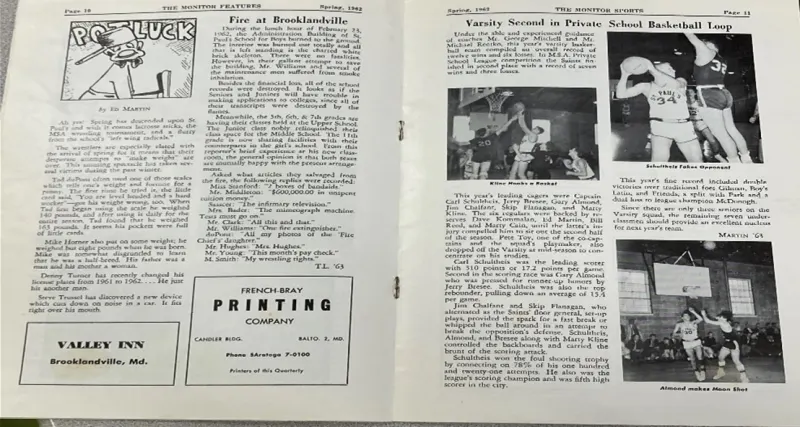
One interesting feature about the early life of the newspaper was its columns. Specifically, Confidential Corner and Pot Luck. These short columns in The Monitor were, unlike the rest of the newspaper, opinion-based, and usually involved gossip and mockery of students and faculty. Making jokes, talking about controversial school issues, and interviews with St. Paul’s students and faculty were regular parts of these columns, which were hugely popular in their time. Pot Luck was originally written by Richard Owen III ‘56, with other writers taking his place however even after he graduated, other writers took his place, such as Dick Peterson ‘61 and Edward Martin ‘63 and Dick Peterson. Confidential Corner’s author was anonymous at the time, and to this day no one knows who wrote the column. (Perhaps with a little more research, we could learn the elusive author’s name.)
However, I hit a bit of a roadblock with these columns. In We Have Kept the Faith, the section about The Page claims that Pot Luck ran in 1956, while the Confidential Corner ran in 1943, without specifying whether they began or ended in those years. The problem is that older Monitor articles have Pot Luck articles written in 1950 and 1959, showing a contradiction in the sources. Confidential Corner also had a similar problem, as I was only found one issue containing it, from 1945. There are many similar inconsistencies, as researching a topic with such a long and complex history such as The Page is bound to lack some incomplete information; however, I’ve tried my best to make this article as detailed and accurate as possible.
Much of the history of The Monitor and The Page has been lost over time. Digging deeply, however, can yield surprising results. I never imagined such an in-depth history of what appears to be an ordinary school newspaper. However, learning about the students who worked tirelessly on these publications over the years tirelessly to create such a professional and unique product as a testament to our school’s history is truly inspiring. There is far more to this history left to be revealed. What happened to The Monitor? How did journalism teacher Mr. Michal Makarovich and his students create evolve into The Page? Who were some of the most defining voices of the newspaper? And what was the catalyst that skyrocketed it into massive school-wide popularity? These questions are difficult to answer in one, especially in a singular article, but stay tuned, as a sequel to this feature, further exploring the past of the Page, as well as its present and future, is coming soon.

An article from The Monitor, from 1962.


Leave a Reply